
#14 "You're an absolute shower..."
Grafting, grifting and cyanide-swallowing: Port Afrique and Private's Progress

Welcome back to The Christopher Lee Project, in which I spend a year tracking down every film made by Christopher Lee and watching them all. I’m Emma Hughes: a journalist, an author and I’m currently wearing two jumpers. Indoors.1
The year is now 1956. In less than 12 months time an audition for a niche film studio on the banks of the Thames will change Christopher Lee’s life forever. Of course, he doesn’t know that yet. So how is our hero, now aged 34, getting on?
After a brief stint on Edgware Road sharing a flat with a ‘rather tricky individual’ who kept bursting into his room in the middle of the night with a gun, my research suggests he has moved back to Chelsea (how many Christopher Lees can there have been writing young fogeyish letters to the Daily Telegraph from SW3?). As well as the films he’s been doing some television, including playing a murderous French fashion designer in an episode of the detective series Colonel March of Scotland Yard, which starred an actor born William Henry Pratt – but better known as Boris Karloff.
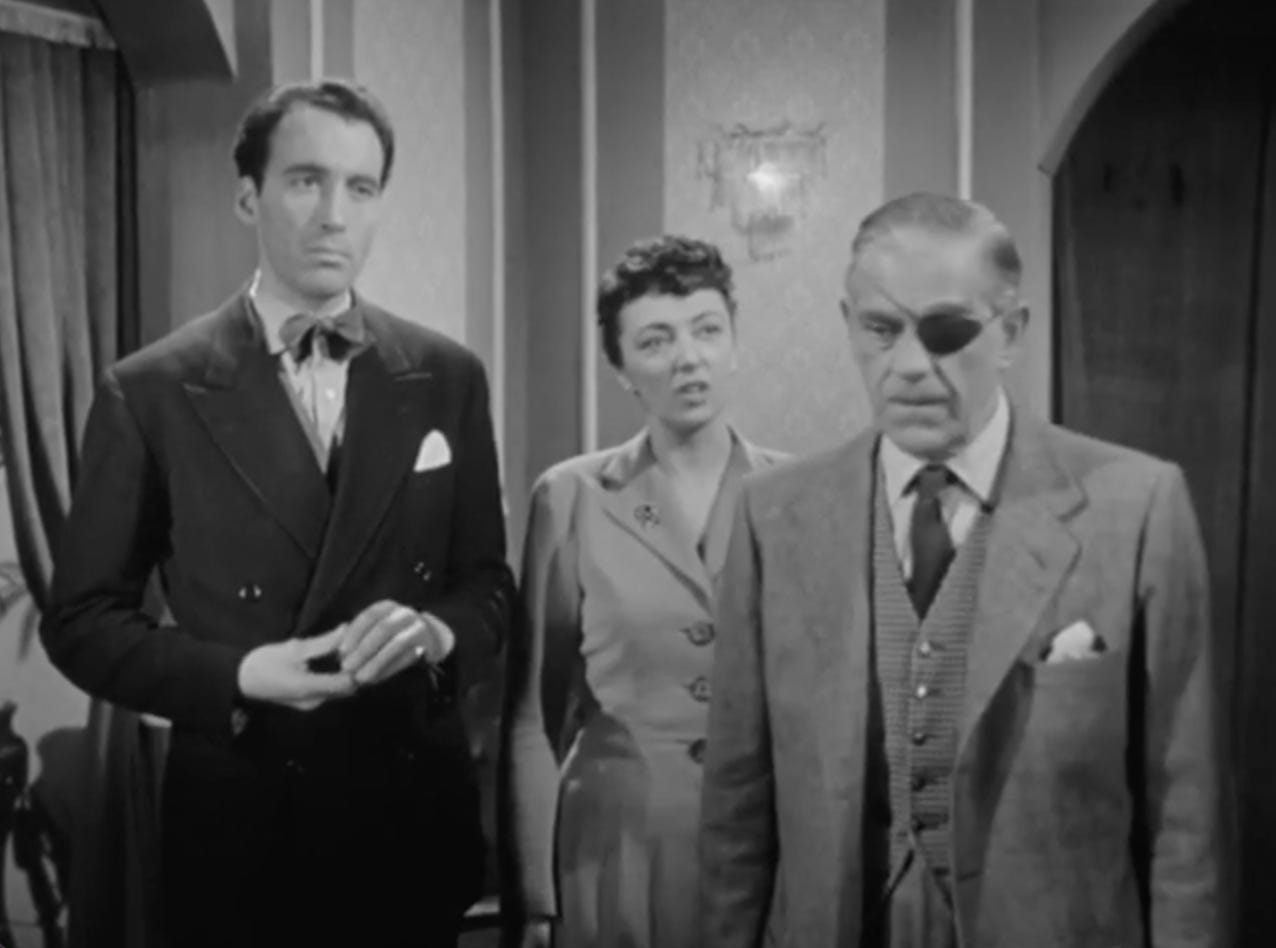
Like most of the ‘silver scream’ giants Karloff was known for being kindly and avuncular in real life, and he warmed to his junior co-star. An actor’s big break, he reassured him between takes, was a matter of persistence and a little luck – he had played dozens of fairly dismal bit parts before being cast as the monster in 1931’s Frankenstein. The young Christopher has absolutely no interest in horror but files this advice away regardless. He also takes note of something else that Karloff, who as Colonel March is sporting an eye-patch, says: that an actor must never be completely faceless, even when that face is obscured.
A lot of television dramas went out live in those days, and most of them were never recorded. What was The Crown of the Andes, a television play broadcast in October 1956 in which Christopher appears to be garotting someone, actually about? I suspect we’ll never know – I can’t find a trace of it online.
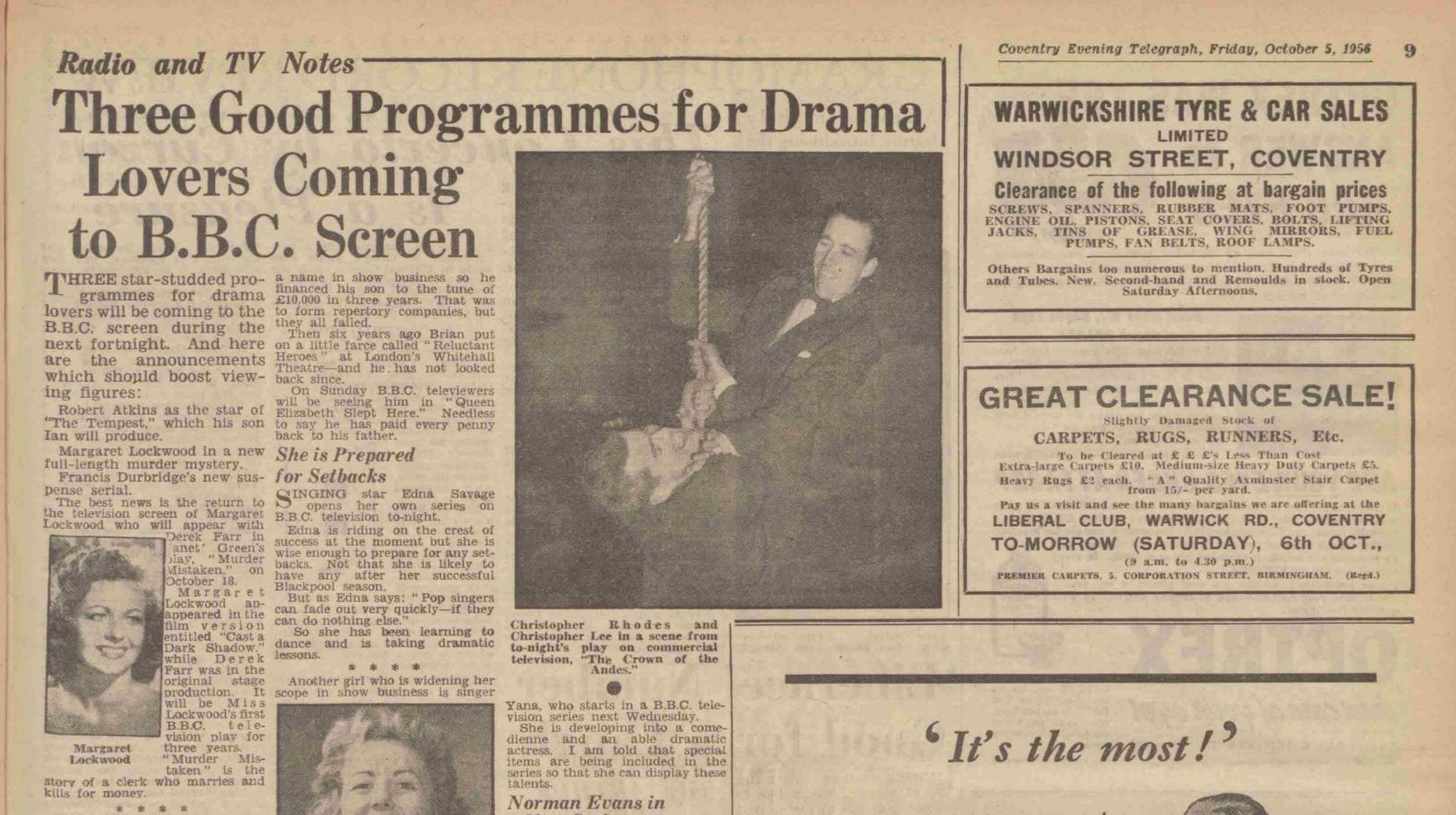
He’s been able to build up a decent sideline in dubbing, both for international markets and to get around the issue of ambient sounds being picked up by what was then still relatively new technology. He is tasked with doing every single one of the voices for the English rendering of Jacques Tati’s Monsieur Hulot’s Holiday, – including the women, which presents some ‘testing moments’ – and is also called on to dub not only in other languages but a dizzying variety of accents (Soho Italian, Detroit Swedish2). C. Lee Dubbing Inc becomes quite sought-after, and the feeling of ‘being thought not only usable but actually wanted helped me survive many a lonely vigil by a silent telephone’, he writes in his autobiography.
He’s busy, then. Which is a good thing for an actor to be. But there are two issues.
Number one, none of it pays enough: despite having top billing in Alias John Preston he took home just £75, the equivalent of about £1,700 today. And that would have been one of his bigger fees. He comes from a historically well-to-do family but the money has long gone, although the familial expectation that he should follow a certain path through life hasn’t, which is source of some angst on top of the anxiety of never knowing where his next (small) pay cheque is coming from. He has become a bit of a man about town, and I suspect he is going out principally so he can have the 1956 equivalent of free Cloudy Bay and Kettle Chips for dinner.
And number two, he hasn’t yet made enough of a name for himself for work to come to him, so he has to hustle perpetually in order not to fade from the Etch-a-Sketch. If you’ve ever stayed in an Airbnb with a log fire you’ll have crouched over the grate with your lower back screaming at you, feeding in endless twists of newspaper and wondering if the sodding thing is ever going to catch. That’s where we’re at right now – and by ‘we’ I mean not only us in the audience, but me in the laboured parallels I have been drawing between myself and our subject. We’re both trying to get that damned fire to stay alight right now.
Anyway, this isn’t The Emma Hughes Project – we’ve got some films to watch. And one of this week’s is actually good!
We’re not starting with that one, obviously.
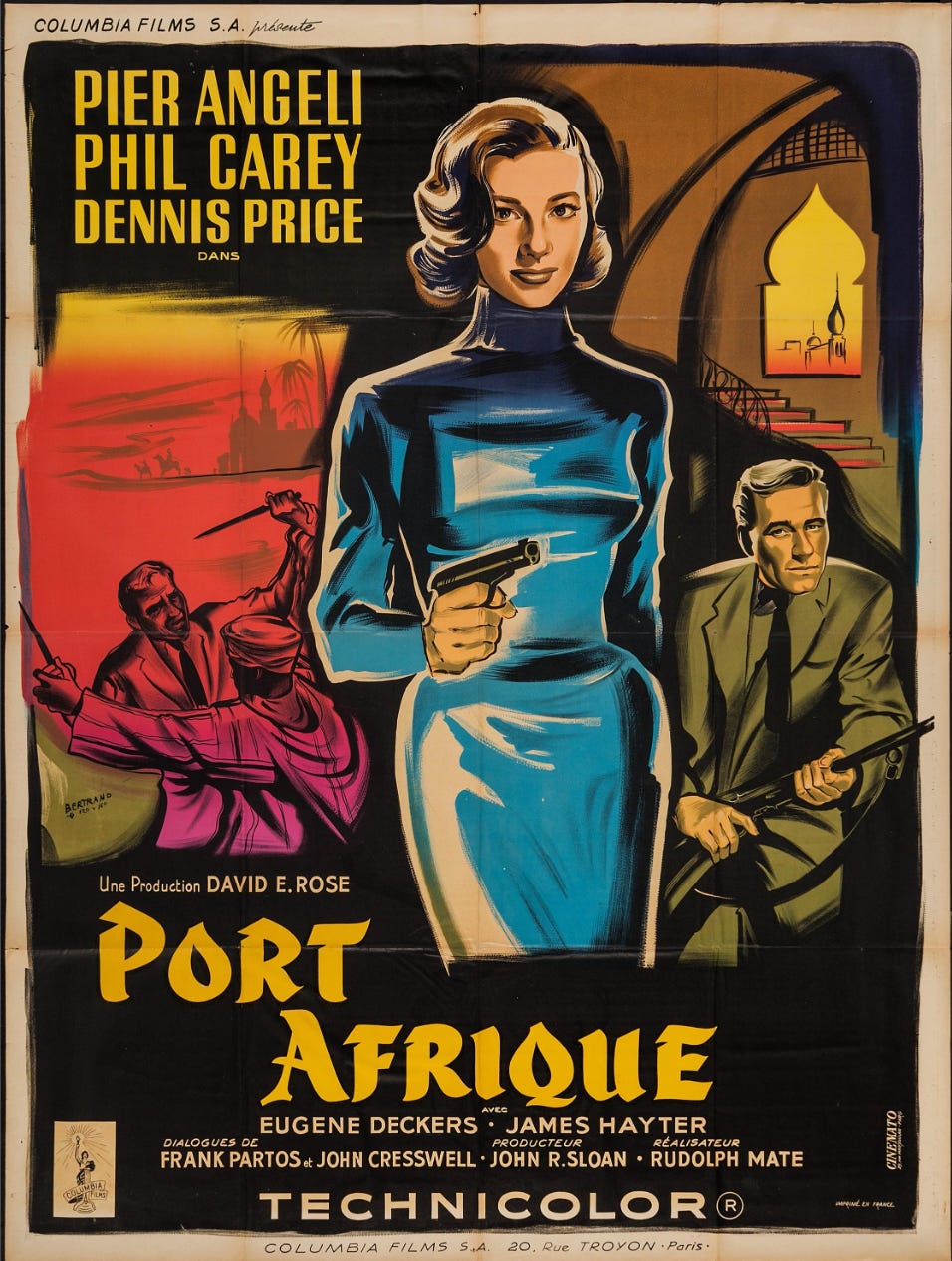
26) Port Afrique (1956)
Last week I mentioned that the question of screen presence was is a useful one for a writer to consider. This week’s first film goes one better – it’s a perfect worked example of a story which really ought to be good (a murder mystery with a great setting) but just isn’t.
Here is the Port Afrique guide to ruining a good idea in 10 easy steps.
1) Whether you’re making a film or writing a book, your location should be a character in its own right. Find a terrific one (in this case Morocco) but make it almost completely incidental to your story (an American war hero returns home to find his wife has just been murdered), and therefore wasted.
2) Spend nearly 20 minutes of the 92 minute runtime setting up the incident which is meant to get the whole plot going. At the same time, have a lot of people talking about the hero being a very brave and good man in place of actually showing him being brave and good.
3) Make the character you are killing off someone the audience have never actually seen alive, so their death has no emotional impact.
4) There is now a death for the hero to try to get to the bottom of: an opportunity for him to prove his mettle and for the audience to connect with him. Instead of just leaving him to it, throw in two detective investigating it in parallel with him.
5) You need some suspects who turn out to be red herrings – two is a nice number. Throw in at least half a dozen, which means none of them have enough screen time to become plausible in the audience’s mind.
6) A stroke of luck: one of your red herrings is played by Christopher Lee, a reliable purveyor of both smarm and menace. Completely fail to make use of him (see below). Also put him in a lumberjack shirt.
7) Never allow any tension to build: resolve misunderstandings almost immediately, make sure alibis are flourished with alacrity, don’t even bother with the nail-biting music.
8) Ensure every character stumbles into each of their scenes as though newly born, with no apparent memory of what they were feeling in the previous one. After the hero finds his wife dead he is put to bed; when he wakes up he seems really quite blasé about the whole business and stays that way for the rest of the film.
9) A small point, but an important one: if you’re filming scenes in what is meant to be a popular seedy nightspot makes sure it is not only half empty but well lit.
10) Finally, when it comes to promoting your film, overpromise wildly by plastering the posters with the shout-line ‘Dramatic as Casablanca! Romantic as Algiers!’ Readers familiar with the publishing world will recognise this as the cinema equivalent of ‘perfect for fans of Nora Ephron’.
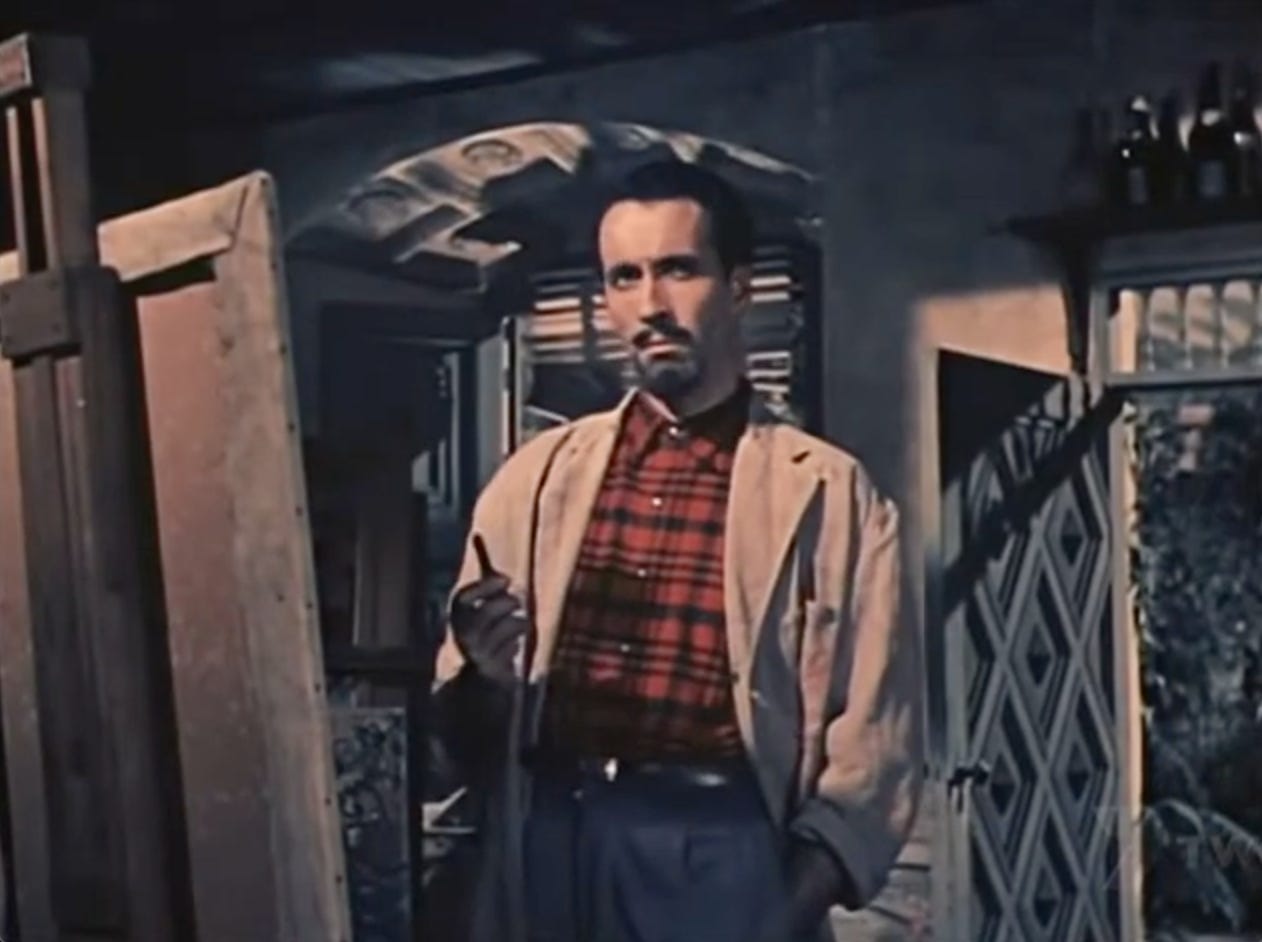
Christopher plays Franz Vermes, artist and ladies man (he is multitasking by painting a naked woman when the police arrive). Bad news if you’re me: the beard is back. Although he has very little screen time, he reports in his autobiography that he did his bit for the production by getting up extra early every morning to drag an unnamed cast member out of a brothel in Tangiers.
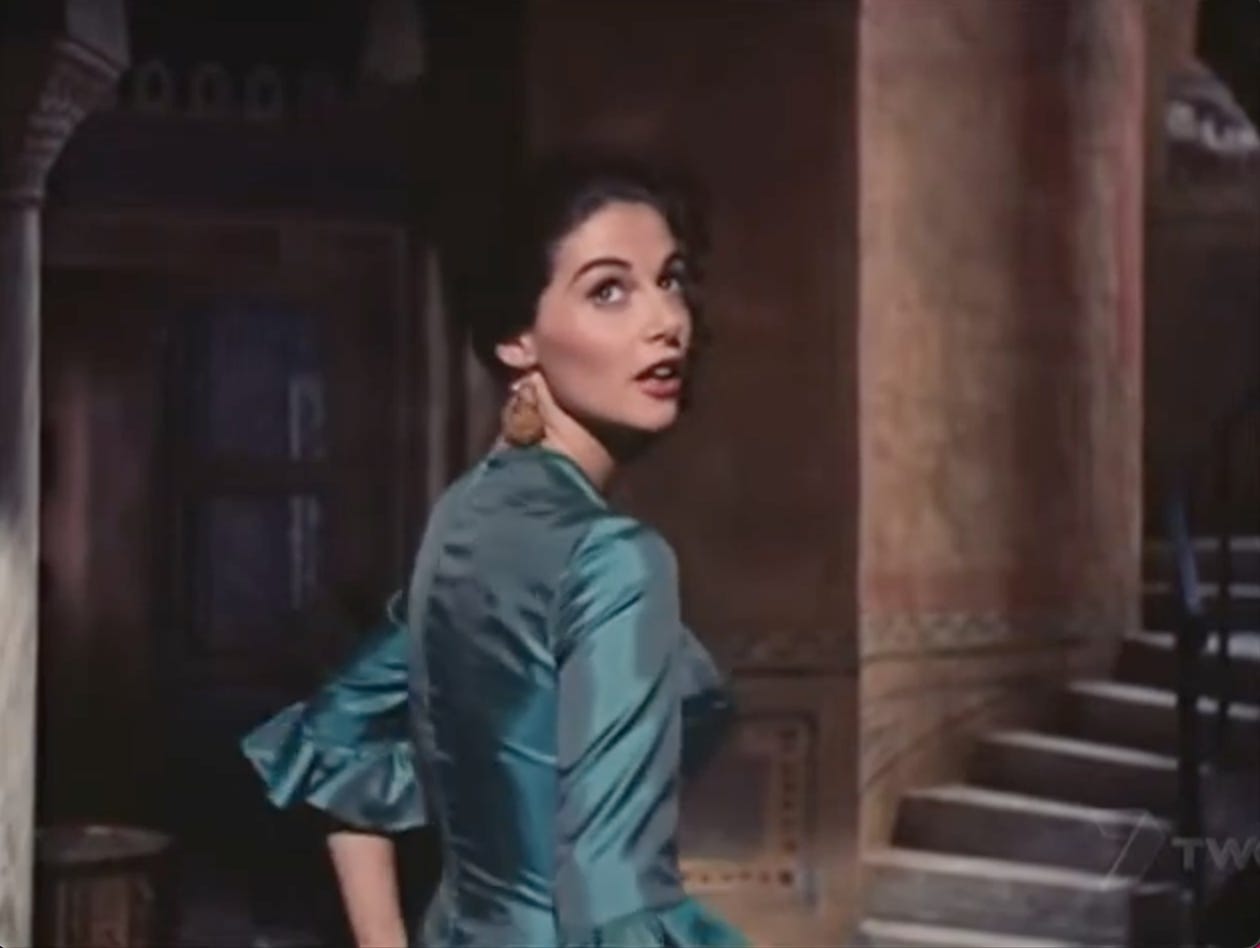
Aside from him, by far the most interesting thing about Port Afrique is Pier Angeli, the Italian model-turned-actress who plays singer Ynez. She is jaw-droppingly beautiful but there is absolutely nothing behind her eyes in this film. I assumed this was because she knew she was acting in a turkey, but then I looked her up and realised the truth was much more tragic. Just weeks before shooting began, the love of her life had been killed in an accident.
His name? James Dean.

Angeli and Dean met in 1954 when they were both shooting at the Warner Bros Studios, where Dean was under contract. They fell immediately and passionately in love, and got engaged shortly afterwards. Unfortunately Angeli’s mother, who had brought her two daughters to Hollywood with the express intention of making them stars, thought Dean would be bad for her image and insisted she break things off, which she reluctantly did in November 1954. A few weeks later she married the singer Vic Damone; Dean was reported to have sat outside the wedding on his motorcycle revving the engine. Less than a year later he was dead, and Angeli never recovered: her career and mental health both went downhill and she died in 1971 at just 39 after being given a barbiturate injection to help her sleep.
Rating: 3/10 (one extra point awarded as penance because I forgot to rate any of last week’s films)
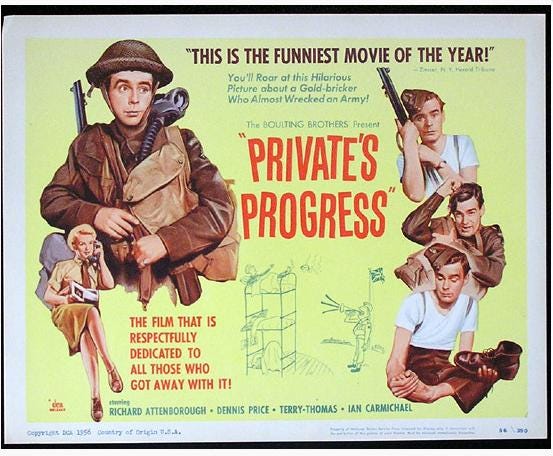
27) Private’s Progress (1956)
As we know, the post-war years saw a boom in cinema nostalgia for the recent past. Most of the films were like They Were Not Divided, rose-tinted celebrations of selfless heroism and sacrifice. But what about the scroungers, the skivers and the grifters, of which there were plenty in Britain during the war and who presumably also had fond memories of it? Who would make a film for them?
Step forward the Boulting brothers, identical twins Roy and John. Filmmakers before and during the war (Roy was a member of the Army Film and Photographic Unit and worked on Desert Victory) after it they began to move from serious drama into satires like 1957’s Lucky Jim. Before that, though, there was Private’s Progress, ‘respectfully dedicated to all those who got away with it’ – ‘it’ in this case being dossing around, making a quick buck and generally undermining the war effort.
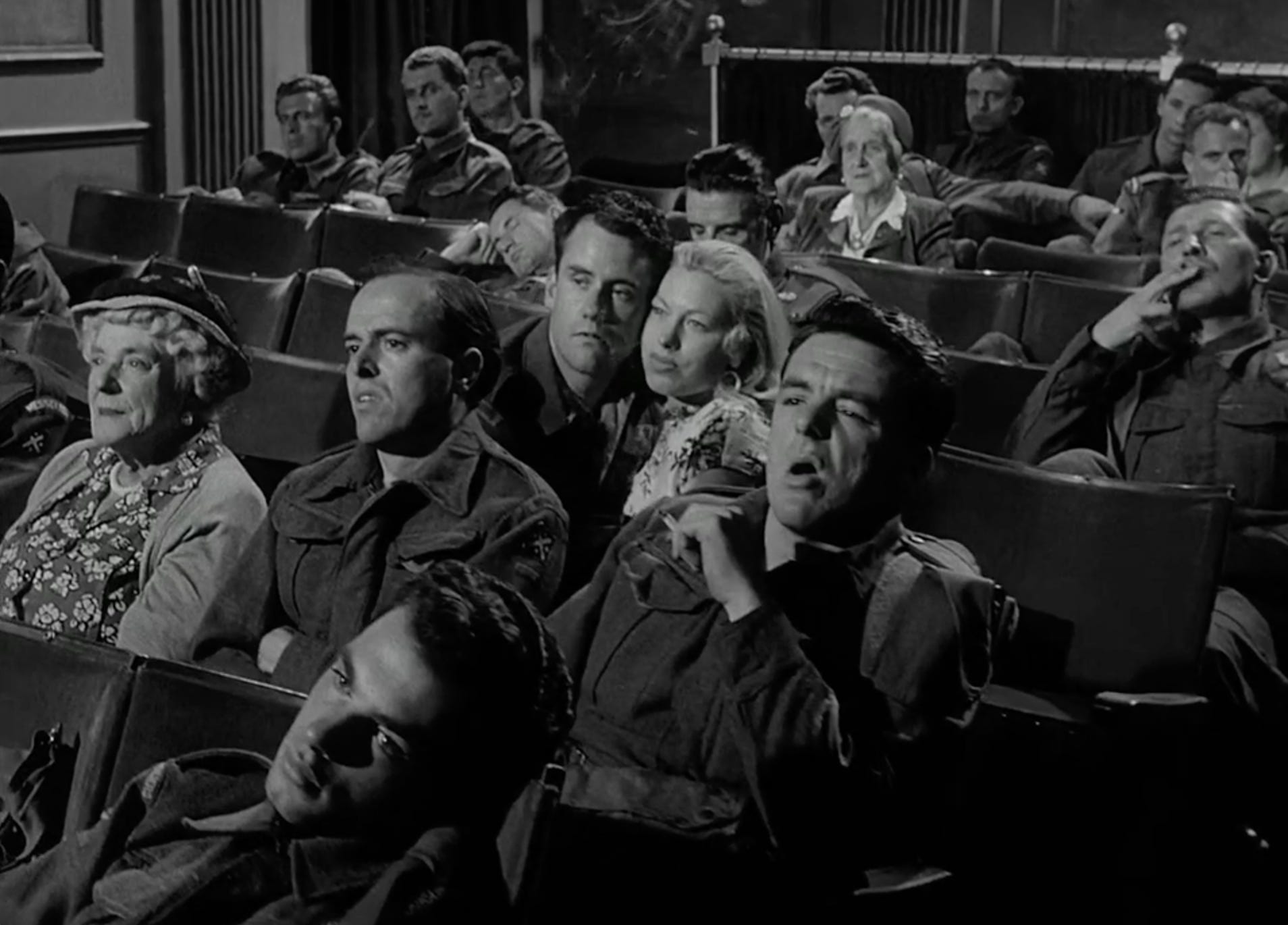
Drippy undergraduate Stanley Windrush (Ian Carmichael, who would go on to play Bertie Wooster a good 20 years before Hugh Laurie) is dragged away from Oxford/Cambridge to join the army. After failing officer training he ends up in a holding unit for hopeless cases, where he falls in with a crew of ne’er-do-wells led by spiv Private Cox (a delightful performance by Boulting regular Richard Attenborough) who teach him how to spend a whole day painting one fence post. Meanwhile, his uncle is up to a different sort of no good in the War Office, where he’s hatching a plan to get rich off stolen Nazi loot – one which he will soon be getting young Stanley mixed up in.
Ian Carmichael is one of those actors whose music-hall comedy style has dated so much that, for me at least, he’s rather a grating screen presence. Even so, it beggars belief that I have never watched this film before, it ticks so many of my boxes. And – yippee! – it has Terry-Thomas in it.
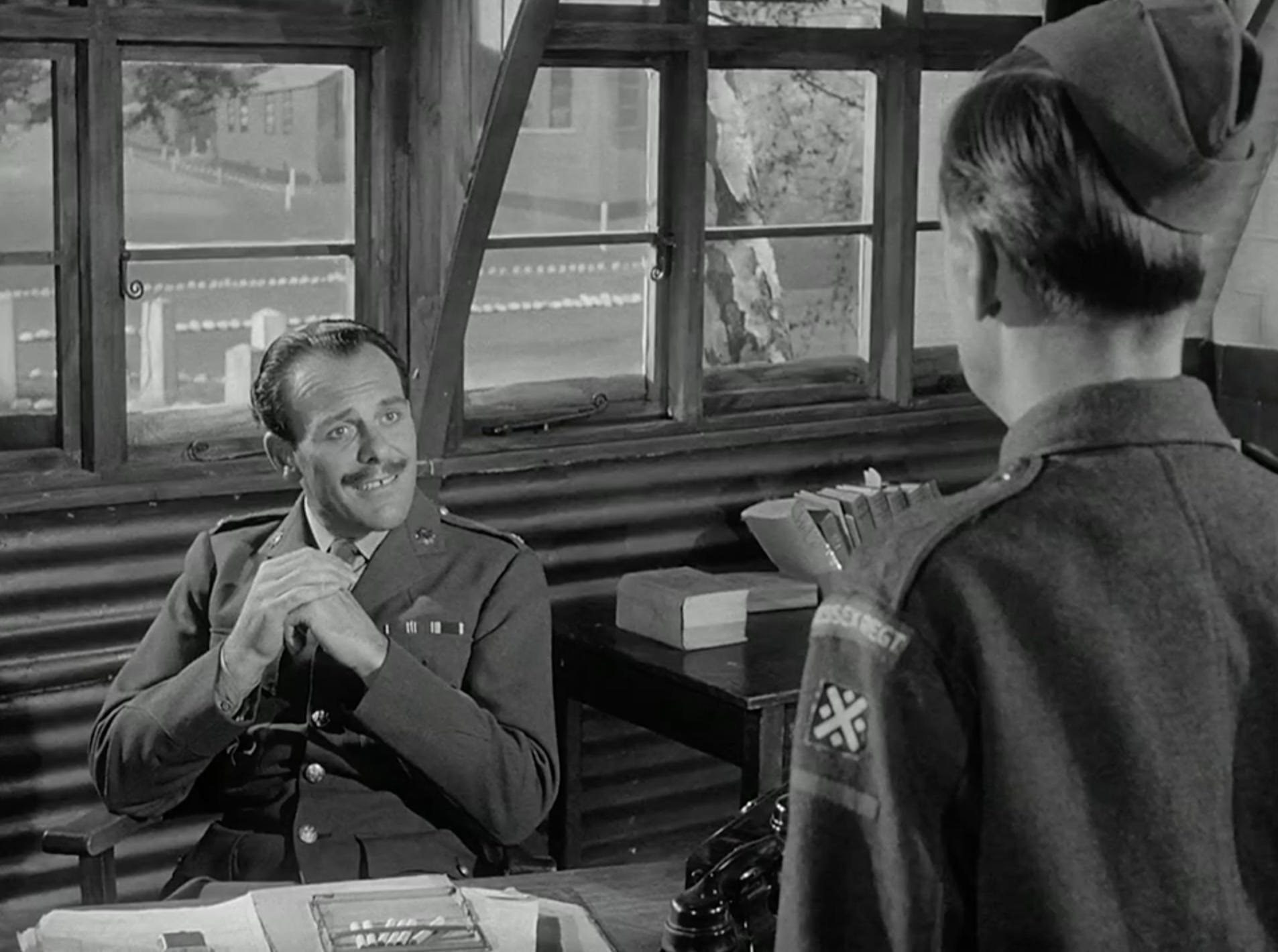
I feel the same way about T-T as I do about Pizza Express: the joy is in the fact you always know exactly what you’re getting, regardless of objective quality. And I really respect his commitment to the bit: he kept the caricatured cad act up at all times, whether he was campaigning to get horse jumps installed in Hyde Park or having his sports car painted to match his favourite cravat. Here he plays Major Hitchcock, the commanding officer of the holding unit, whose catchphrase – ‘You’re an absolute shower!’ – is regularly bellowed at his malingering men. It would be more effective it he wasn’t also always bunking off to go to the pub.
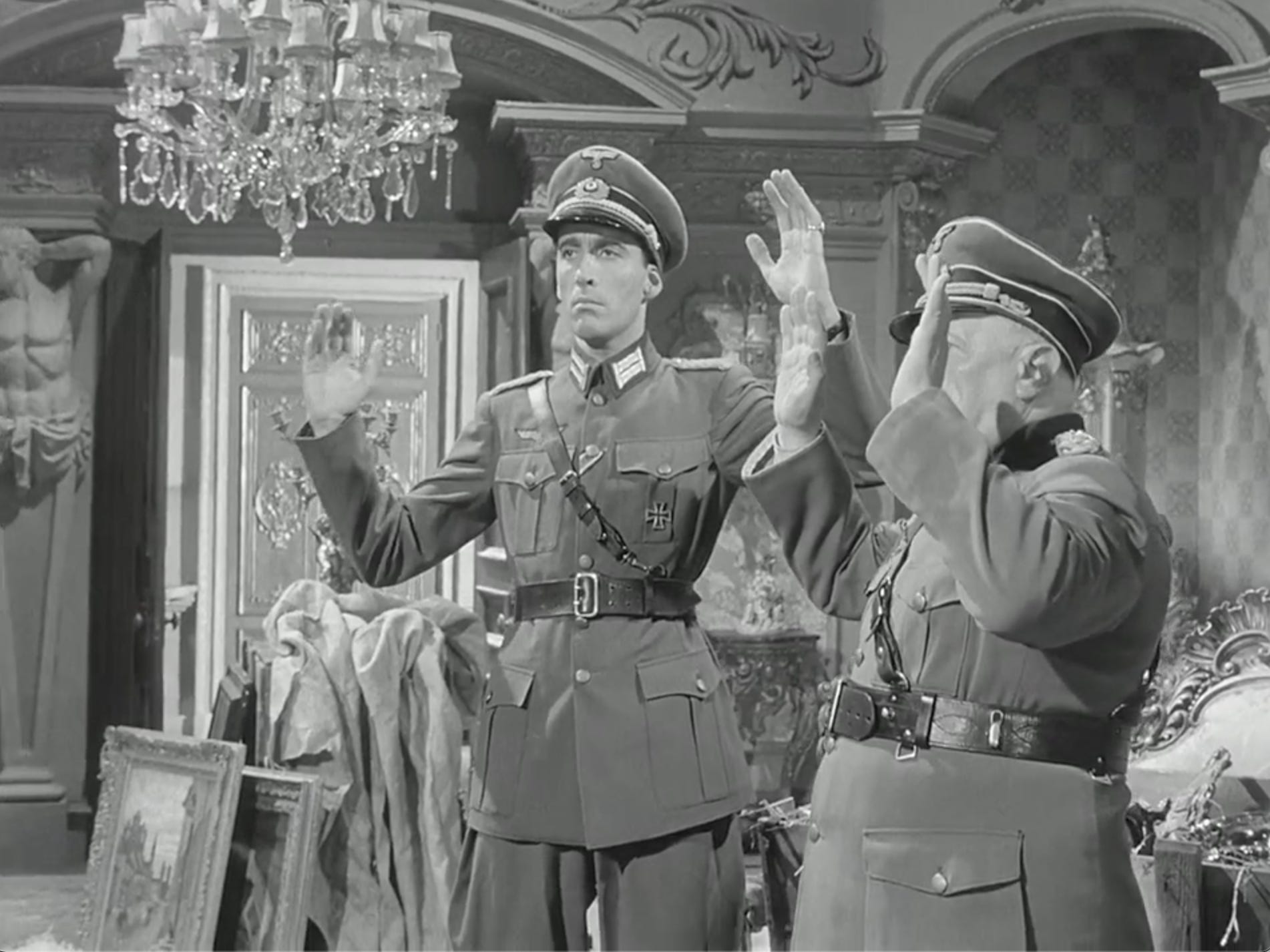
Christopher is Major Schultz, the aide to General von Linbeck, whose castle full of stolen art the English crooks are about to steal all over again. This is his first time playing a Nazi but it won’t be his last: German actors, understandably, were reluctant to do it, so an Englishman who spoke fluent German was an obvious go-to. Given the tone of Private’s Progress I had assumed he would be playing a comedy Nazi, if that isn’t a contradiction in terms, but he’s actually really sinister, dripping disdain for the full five minutes he’s on screen.
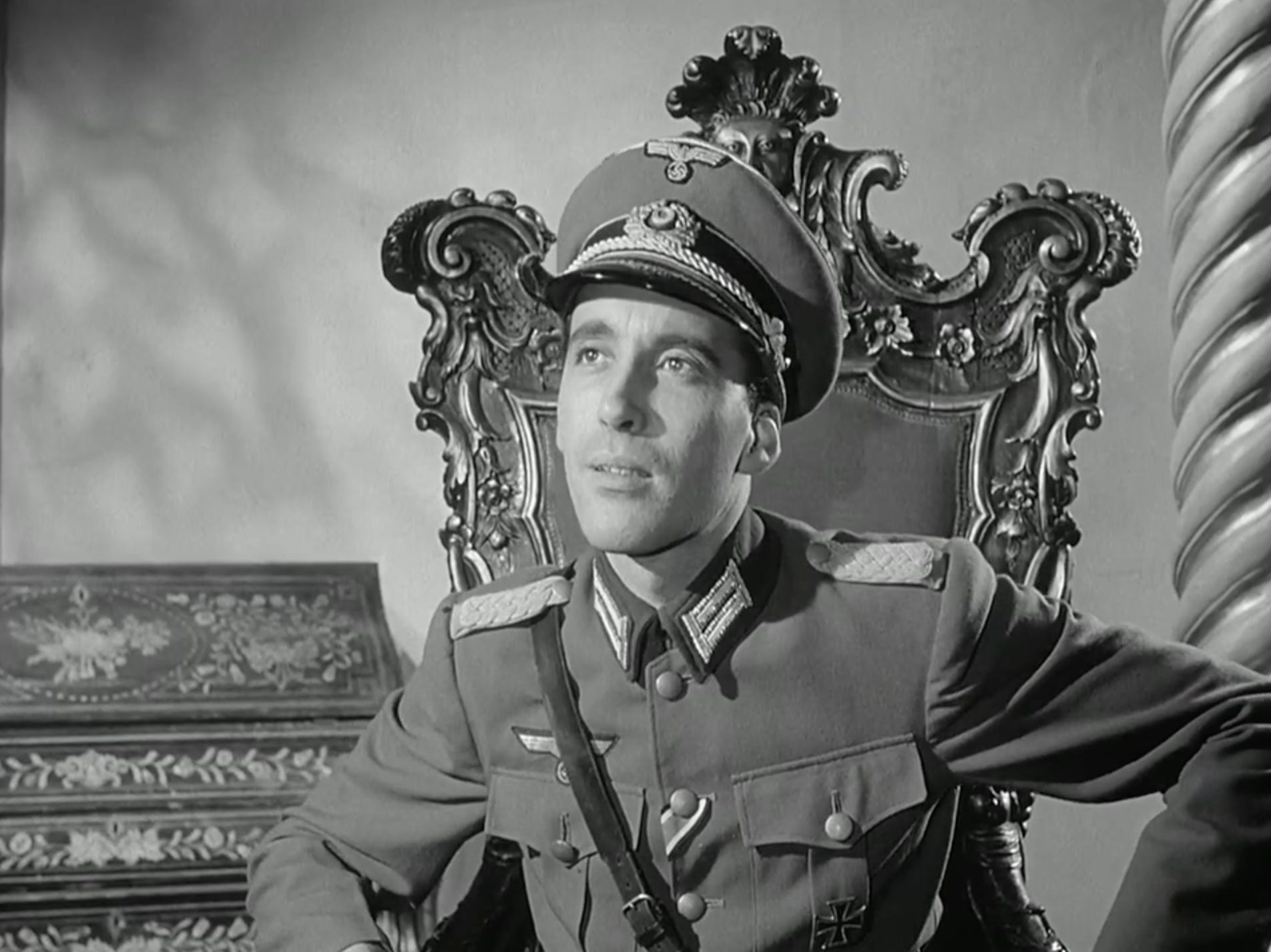
He manages to con Stanley into passing him a bottle of cyanide pills, one of which he takes; his first screen-death by poison but not, I suspect, his last.
Rating: 7.5/10
Next week on The Christopher Lee Project: we really are nearly at the good stuff, I promise
No audio this week, again. I know, I know – I’m sorry. I miss it too! I really do love doing it, but when I embarked on this stupid idea important research project I hadn’t reckoned with quite how time-consuming it would be to do it properly, compared to just Writing A Thing. To edit a 15-minute recording with all the music and so on I need a spare two hours, and I just haven’t had that this week for various reasons.
Speaking of Swedish, Christopher has been picking up some work over there too – as a singer. While filming Valley of Eagles in Stockholm he ended up in a pub where a schnapps-fuelled singalong was taking place. After one particularly rousing rendition a fellow drinker tapped him on the shoulder and asked if he’d ever thought about doing it professionally. The man turned out to be the famous Swedish tenor Jussi Björling, and an audition at the Opera House followed. This didn’t go anywhere: his voice was declared to be an oddity, somewhere between a bass and a baritone with bits of tenor thrown in, which must really have poked a bruise. But the touring opera companies of Sweden are happy to have him, so he’s spending a few weeks a year in the woods belting out The Flying Dutchman for kroners.
Glad to see the C Lee project back from the dead.