
#19 The monster mash
In which the blood-soaked Curse of Frankenstein press tour gets underway, and our hero has to make a difficult decision. Plus: a creative experiment

Welcome back to The Christopher Lee Project, in which I spend a year tracking down every film made by Christopher Lee and watching them all. I’m Emma Hughes: a journalist, an author and there’s something a little bit different at the end of today’s episode.
When I started this project I thought of press tours as a modern irritant, like Lime bikes or Evri delivering your Vinted parcel directly to the bin on bin day. Turns out I was wrong.
Long before Jacob Elordi batted his eyelashes at Margot Robbie and Zendaya stood next to Robert Pattinson in a Twilight t-shirt, there was the 1957 press tour for The Curse of Frankenstein. This, I would suggest, laid the foundations for all of the above, in that it was gimmicky, shameless and worked like a charm.
Leslie Frewin, who Hammer hired to do their PR, was the master of what we would now call the publicity stunt: in 1953 he had arranged for a thousand steps to be built up the side of a mountain in Scotland so reporters and photographers could drink champagne at the top while they watched a battle scene for Rob Roy being filmed. He understood something which is as true today as it was then – if you want to get journalists on side you need to give them a) a good story and b) alcohol.
For The Curse of Frankenstein he threw a cocktail party just after filming wrapped in late November 1956, in an abandoned warehouse by the Thames which had been decorated with sawdust, rusty wire, broken glass and cobwebs. There were horror-themed drinks like ‘The Blood of Frankenstein’ (blackcurrant and brandy), and glass apparatus bubbling red liquid gurgled and hissed in the background. Everyone had a lovely time.
Well, almost everyone.
If Christopher had hoped he might be allowed to quietly enjoy a nice cold drink with the gentlemen of the press he was sadly mistaken. Leslie Frewin had guessed – correctly – that he would be willing to do almost anything to give the film, and by extension himself, a better shot at success. Back on goes the monster make-up and bandages, and over to Moore Raymond of the Sunday Dispatch, who was there:
A woman screamed. The heavy iron doors creaked open. There stood a hideous monster with the limp and lovely body of a girl in his simian arms. Flash, flash, flash! While the photographers got their pictures, we writers peered through the murk at Hazel Court in the evil power of Christopher Lee. The monster retreated with his victim. The doors creaked shut. We returned to our drinks.
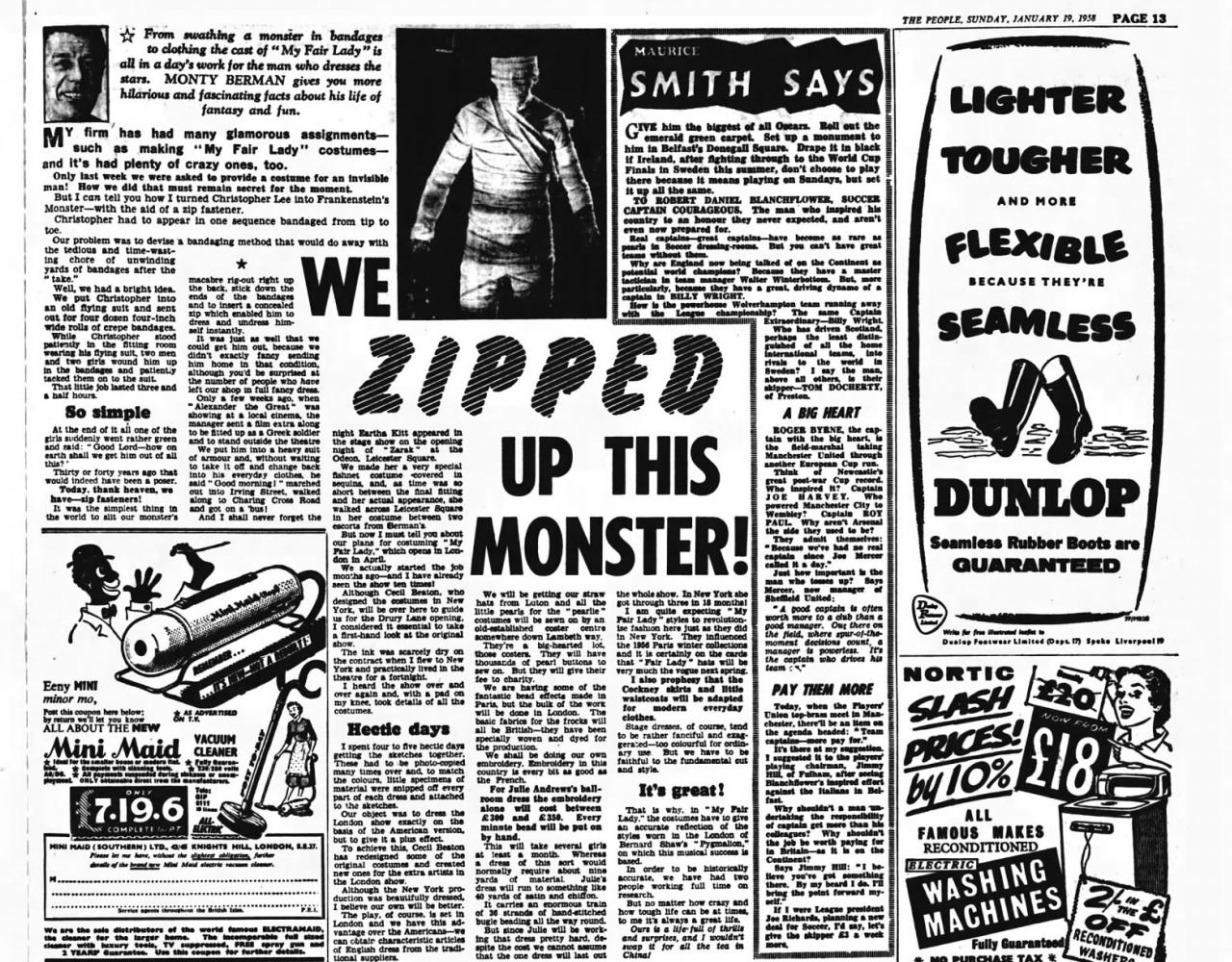
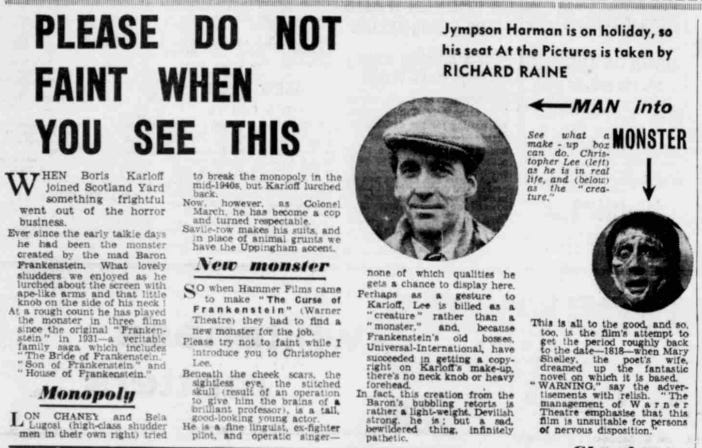
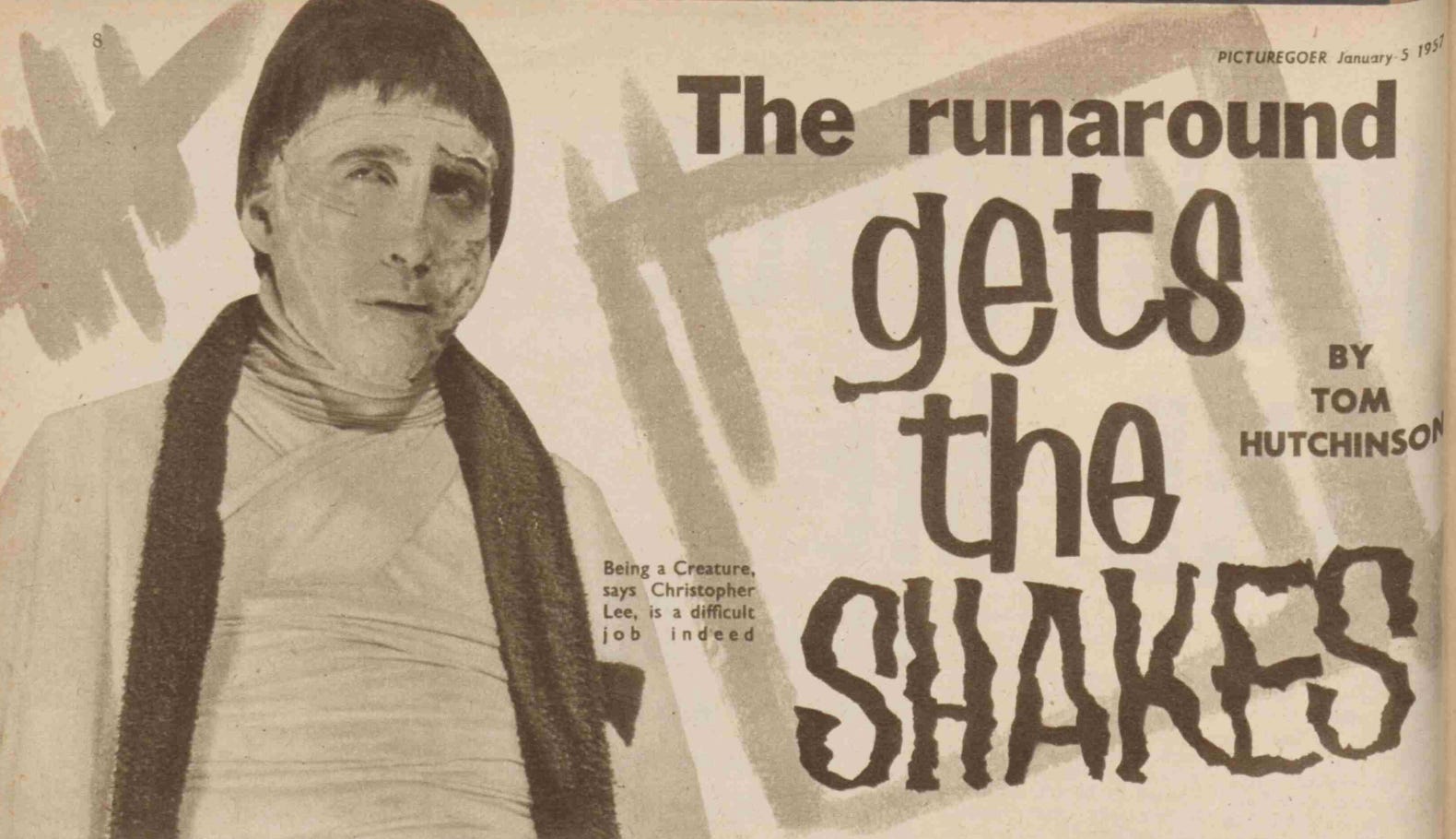
This was just the start of his promotional obligations. Leslie Frewin organised a meet-and-greet with Picturegoer, the influential film magazine, in which he was required to demonstrate various monster moves (Peter Cushing got away with talking about sheep’s eyeballs). A story was placed in the People about how his costume was created, and he had to pose for before and after photos to accompany one about his monstrous transformation which was syndicated all over the country with the headline PLEASE DO NOT FAINT WHEN YOU SEE THIS.
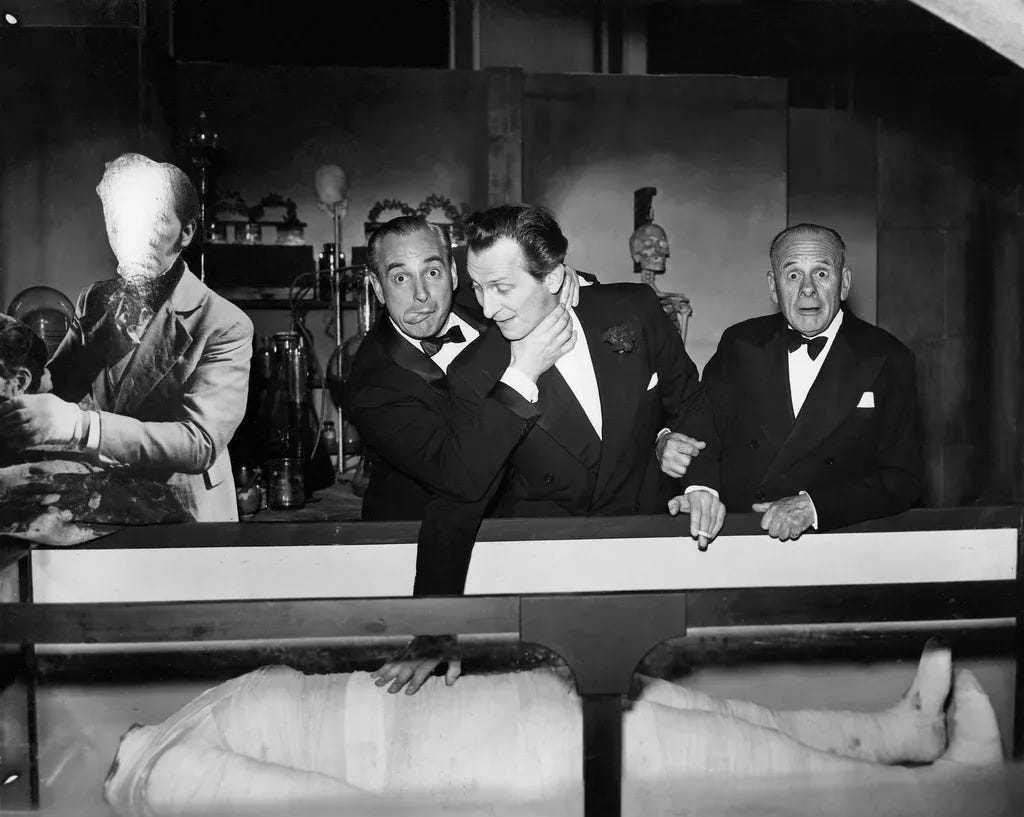
All of this coverage jazzed people up for the premiere, which became one of the most hotly anticipated of the year. It took place on May 2 at the Warner Theatre on Leicester Square, now the Vue West End. Hammer really went to town on the decor: there was a sign reading WARNING: The management of Warner Theatre emphasise that this film is unsuitable for persons of nervous disposition, the whole upstairs foyer was lit a ghoulish green, and it contained a scale reproduction of Frankenstein’s laboratory, complete with a tank containing a headless, bandaged body.
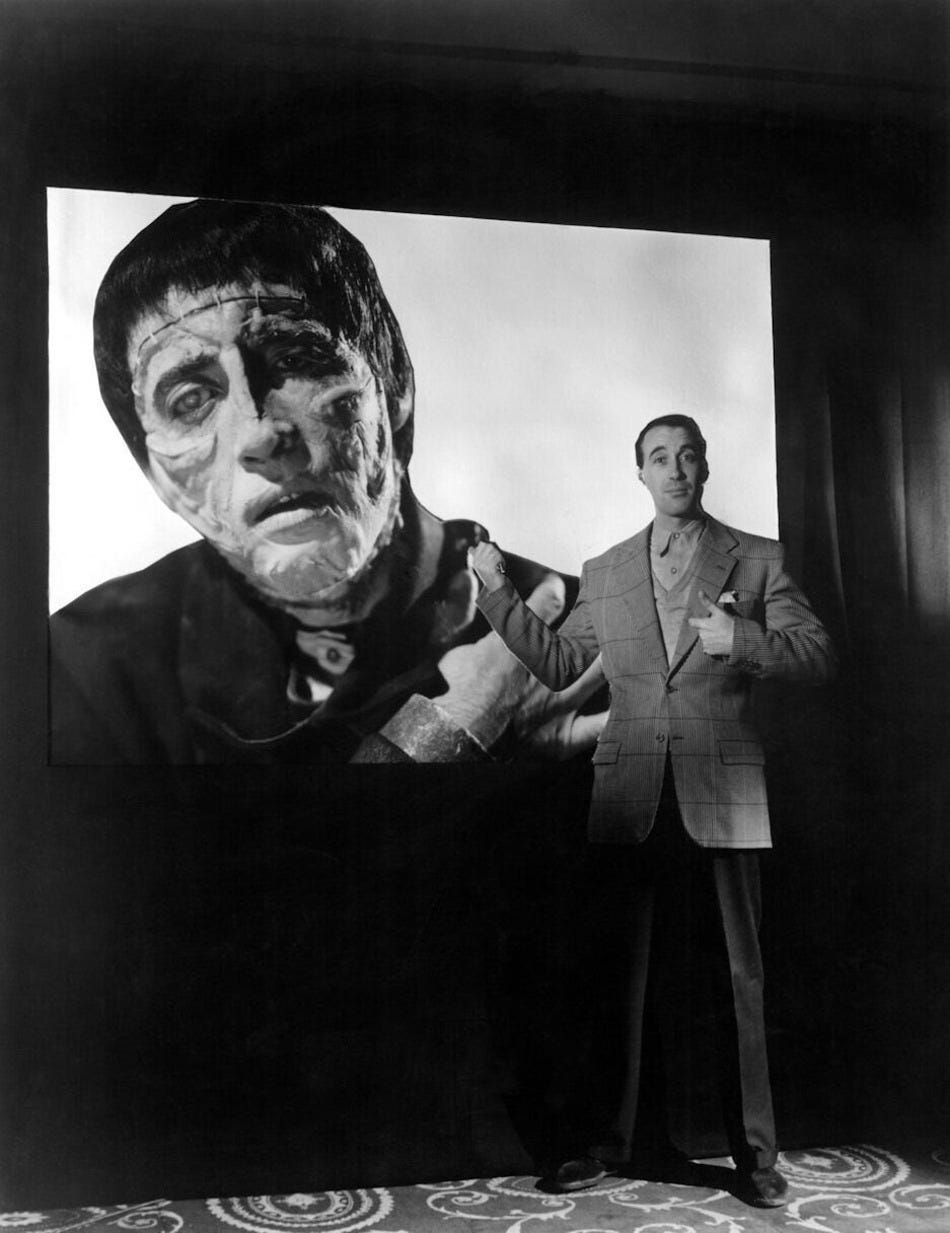
For the first time in his career Christopher found himself besieged by reporters on the red carpet. What was it like playing such a hideous creature? What sort of part would he like to play next? Was there anyone special in his life? Yes, he replies to this last question: he has a fiancée in Sweden. She couldn’t be here this evening but she’s seen pictures of him in the make-up. And what did she say? “Ghastly,” he laughs, and everyone else laughs too, although anyone paying close attention might have spotted that his smile didn’t quite reach his eyes. The following week a story runs in the Daily Express with the headline MONSTER TO MARRY.
Behind the scenes Hammer had been arm-wrestling with the British Board of Film Censors. Knowing the bright red Eastmancolour blood – the first ever seen in Britain, remember – was going to be a sticky (sorry) point, they tried to be sneaky by submitting a black-and-white print for approval without reminding the BBFC that the film was actually going to be released in colour.
The BBFC wasn’t fooled, but this was uncharted territory. As the film historian Paul Frith puts it: “Though the BBFC team had been accustomed to dealing with horror in the past, they now found themselves in a position wherein they would be required to make recommendations as to what may potentially be prohibitive in colour for a film genre that had previously been associated with black-and-white photography.”
In the end, they were pretty lenient with Hammer – far more so than they would be with Dracula. Their requested cuts were minor:
There is one cut which I feel sure we shall have to ask you to make and you might as well do it now – and that is the shot in Reel 3 of Frankenstein wiping the blood off on his overall after severing the head. It is also the colour factor which has influenced our request, made above, for the shot of the head being dropped in the tank to be removed.
What did audiences make of all the Kensington Gore? They were reported to have squealed, gasped and shrieked, with some even fleeing the cinema in terror. The press bashed out their reviews, which ran the following week. The Curse of Frankenstein got a rave from The People, which called it “the acme of all horror films” with “no let-up in the ghoulish business”, and also commented on the realism lent by colour. “Even Boris Karloff would have been scared!”
Writing in the Sunday Express, Milton Shulman (whose daughter Alexandra would grow up to become editor of Vogue, and my former boss) was more ambivalent about the “macabre relish for details” and all the blood (“by comparison an abbatoir is a rather friendly place”). He described Christopher’s Creature as having “the general air of something that has just lost a wrestling match with a cement mixer” who “shambles somewhat pathetically to his doom”.
“I have no appetite at all for horror pictures,” wrote Tatler’s Elspeth Grant, but she was grudgingly impressed by both Peter Cushing (”chillingly effective”) and Christopher’s portrayal of the Creature (“played with a certain awful pathos… egregiously hideous and no advertisement for Frankenstein’s ‘Do It Yourself’ methods”). “The poor thing has a perfectly terrible time,” she concluded with a sniff.
The critics might have been unsure, but audiences certainly weren’t – The Curse of Frankenstein brought in more than 70 times what it had cost to produce during its original UK cinema run. When it opened in America the story was the same: it grossed $30,900 in its first week in Los Angeles alone. It went on to break box-office records left, right and centre (“We made a hundred thousand pounds in Japan alone with that film,” producer Tony Hinds later told Picturegoer) and everyone was delighted.
Well. Almost everyone.
Cast your minds back, if you will, to Episode 17 and the story of Christopher’s engagement, which in his autobiography he set in 1959 but which actually happened in 1956-7.
His would-be father-in-law, Count Fritz von Rosen, was horrified and determined to send him packing. I think we can safely assume that the news of his casting in The Curse of Frankenstein had made him even more so – the only thing worse than an out-of-work actor was an actor whose name was rapidly becoming associated with the sorts of lurid films that were banned in Sweden.
Not long after the Thames warehouse party, Christopher flies out for Christmas with the von Rosens. The Count tries every trick in the book, from telling him the wrong dress code for things to plying him with aquavit before compelling him to make a speech in Swedish. When none of these ploys succeed he lays down his trump card: for some obscure reason Christopher must ask the King of Sweden’s permission to marry Henriette. As it happens Christopher actually met the King some years before, because of course he did, so he writes to him and receives his bemused assent.
At this point, in Christopher’s version of events, the Count realises that he has met his match and withdraws his objection to the marriage. The wedding is on. Henriette flies to London.
And Christopher breaks up with her.
It was seeing Henriette in London that brought reality into the fairytale… She was an utterly sweet young lady. And it occurred to me that the person who had shown me the barren nature of my disaffected relations with women deserved better of me than to be married to me and pitched into the dishevelled world of an actor. So one day in my second-hand Mercedes parked in Eaton Square I told her that it was off.
Even leaving aside the discrepancy in timings – which we’ll get to shortly – I don’t buy this for a second.
For one thing, he had already seen her in London: she’d visited the previous October. He was introspective to a fault – would it really have taken him this long to realise their hopes and dreams were incompatible? But more importantly, he would have known that in Henriette’s very small, conservative world, breaking off an engagement at the last minute would likely have affected her future marriage prospects. Nothing I have seen or read has given me the impression he was the sort of person who would do that to a woman he had loved.
Of course, if Henriette had called the whole thing off – or if, say, her father had put his foot down due to being horrified by The Curse of Frankenstein – that would have been a different matter. No disgrace in that.
Let’s go back to when he and Henriette actually met: 1956. A low point in his career, when the prospect of giving up acting and perhaps even leaving the country for a more traditional life must have been very appealing. Nine months later things are completely different: suddenly the success he has dreamed of is within reach. But if he marries Henriette he will have to forget all of that and focus on being the right sort of husband for her. I suspect he didn’t want to get into all of this in his autobiography, not least because Henriette was still alive when he wrote it, so he just moved the story into 1959 so it could be made to seem much simpler.
What we are dealing with here is a jigsaw with half the pieces missing. All we know for sure about Henriette’s side of the story is that she wasn’t at the premiere and that she married someone else quickly. But I spend a lot of time in my other life writing around the edges of history, trying to work out what people might have been thinking and feeling, and I do think that can get you quite close to the truth sometimes.
So with that in mind, I’d like to try a little experiment. If you’d like to listen to this bit too, you can skip to 12:36 on the audio at the top.
***
Imagine, for a moment, that you are Henriette von Rosen.
You are 24, and your life has been turned upside down by an Englishman you met in a nightclub. On your second full day of knowing each other, after a morning of sightseeing in Stockholm, you catch the tram out to the forest and walk to the waterfall together. When you reach it he gets down on his knees – both of them, for emphasis, with touching clumsiness – and asks if you would do him the very great honour of marrying him
You say yes, of course. Your whole life has been leading up to this, the moment when the door to your destiny as a wife and mother is finally opened. You are one of the last of your friends to marry, and although you generally do not envy them their husbands, all as plain and dry as biscuits from the same tin, you don’t want to spend the rest of your life under your parents’ roof. And deep down you have never stopped believing in the fairytales you were brought up with.
In the four or five seconds it takes for you to give your answer you watch his face crumple in anticipation of rejection, and if the awful wrenching feeling this triggers in you isn’t love then what is? He feels terribly adrift in London, he told you on the night you met, like a fairground balloon being blown about in the wind. You have never been good with words like he is, so you crouch down in the grass and take his hands and squeeze with all your might, hoping he understands that he never has to drift again now he has you.
It was always expected that you would marry a man whose family had known yours for generations. Your mother and brother take the news that you are instead engaged to an actor you met 48 hours ago pretty well. Your father, who is in poor health, does not. As he rants and raves about what everyone will think of you, you understand that his real fear is what everyone will think of him. The shame of losing all that money before the war clings to him like an oil slick, and he moves through the world with his fists up as a result. He says he will not give you his blessing unless you wait a year.
When you’re brushing your hair that night your mother comes to sit on the edge of your bed, like she used to when you were a girl. He’s from a good family, she says in a gentle, reassuring voice. This business with films… it isn’t forever. Men have these ideas, but they know they have to give them up eventually. Sometimes they just need a little nudge.
You fly to London – your first time on an airplane, in a new suit and a pillbox hat and gloves – to meet his mother. She receives you propped up in bed like a dying queen, and after sending your fiancé out on some spurious errand confides in you her hope that now he has met such a lovely and suitable girl he will want to forget this acting nonsense, which is so clearly going nowhere. She strokes your hair and calls you a sweet angel, the answer to a prayer, the best thing that has happened to the Carandinis in a century.
London, a gigantic polluted building site, is enjoying an Indian summer. You swap your suit for a sundress and the two of you hire a rowing boat on the Serpentine. He somehow manages to lose both oars in the water, and when the attendant comes out to shout at you he pretends you’re French tourists who speak no English. The city is overwhelming, so loud and crowded, but he walks you to the door of your cousin’s house every evening after dinner and kisses you goodnight and it feels like the gulps of champagne you used to sneak when your parents had parties. You lie awake for hours fizzing with happiness.
On your last day, over a greasy cafe breakfast which you find anthropologically fascinating but inedible, he shows you a script he has been sent for a new film about Frankenstein’s monster. His agent has suggested he audition for the part of the monster, which makes you both cry with laughter. You read the script together, agreeing that it is terrible, and he reaches for your hands across the table and tells you he doesn’t know what he’ll do without you when you go home.
Both of your mothers were right, you think on your way to the airport: he will surely be relieved to give all of this up. Perhaps he might even want to leave London for Sweden. That would be so much nicer. You try to imagine him folded into your life there, hunting with your father on Saturdays and sitting in the family pew in church on Sundays, knees bumping the one in front. The picture flickers like a television in a storm. Perhaps with practice you can get it to stick.
He gets the part in the monster film. Filming begins, and within a week everything has changed. Suddenly your telephone conversations are full of new names, people he has met on set and is already getting along famously with. But it isn’t just that which makes you feel like the balloon being blown around. He wasn’t lost before you met because he didn’t have you, you realise – it was because he didn’t have this. He will never give it up, you can see that now. And even if this film brings him the success he has been chasing for so long, that won’t be the end. He is climbing a mountain with no peak. And anyone who marries him will just have to accept that.
He posts you the particulars of a flat in London he is considering making an offer on, because it overlooks a square and he knows how much you love being in nature. The square, which is about a quarter of the size of most people you know’s gardens, was bombed in the war and everything has grown back scrubby and brown and wrong. You tell him it’s lovely.
Your father, meanwhile, continues to fling grenades at the situation despite – or perhaps because of – his failing health. He demands references and even hires a London private detective to spy on your fiancé, hoping to catch him gambling or with another woman. When you find this out you don’t speak to your father for a week, which makes you feel wretchedly guilty. His general unhappiness is not your doing, you know that, but it is within your power to remedy some of it – and you are choosing not to. You do not have many years left with him.
You get up early to make the most of the daylight and spend hours walking around Stockholm, newly appreciative of all the cafes and parks which once felt so stiflingly familiar. One of your old dancing-partners returns to take over the family farm and asks if you’ll have dinner with him. You hesitate for longer than you should before saying no.
Your fiancé comes to Sweden for Christmas. He dodges all the metaphorical blows your father tries to land with aplomb. But this time there is no bubble of pride swelling in your chest as you watch him charming everyone, joining in the singing after dinner with gusto and proposing word-perfect toasts in Swedish. You feel as though you are witnessing an audition for the role of your husband – and you wonder whether, in his desperation to be cast, he has lost sight of the fact that this is a part he will have to play for the rest of his life.
There aren’t many kisses because you are never left alone for a single moment, but when they do happen they feel less like champagne and more like the flat drinks at the end of the night when you should have gone home an hour ago. Several times, during meals, you catch your mother watching you, and the look on her face makes you shrivel up inside. She wouldn’t be worried if you were happy. But she knows you aren’t.
You are supposed to go to England for the premiere of the monster film but your father’s health gives you a reason to stay at home. Your fiancé is much more understanding about this than you expect him to be. Your relief curdles into shame.
The film is released. Not in Sweden, where there are laws against that sort of thing, but you read about it in the English newspapers you have delivered so you can make good conversation when he telephones. You cannot understand how someone so sensitive and cultured could bear to associate themselves with such a horrible thing. He sends you a signed photograph of himself in his monster make-up and you hide it in a book, ostensibly because you don’t want your father spotting it but really because you can’t bear to look at the bit at the top where he has written To Henriette, my wife-to-be.
This is what he wants. And a wife is supposed to want what her husband wants.
You can feel your uncertainty colouring every conversation you have, bleeding into your words like ink in water. You find yourself tutting when he’s later telephoning you than he said he would be or sounds as though he’s had a few drinks, while he becomes snappy and short-tempered, sometimes enough that you can justify putting the phone down, the dishonesty of which makes you feel thoroughly shabby. You don’t say anything to him about how you’re really feeling. You wouldn’t know where to begin.
You never make it to a year. Perhaps your father writes to him and gives him an ultimatum. Perhaps the ultimatum is addressed to you before you leave for your second visit to London, and you relay the message without distancing yourself from it. My father says that if you don’t get a proper job he’ll…
You have known for a long time that if he has to choose between you and his career, he will not choose you. And he doesn’t.
Your final conversation takes place in the car he bought with money from the monster film, during a downpour. You cry. He does too at the end, and you sense that his tears are not just for you but for what you have always represented. When you fly home a door to another life will close forever.
You never see him again. Except you do, on posters outside the cinema once the law changes. Even if you wanted to watch them – which you don’t – the films aren’t the kind that someone in your position ought to be seen queueing up for. Sometimes you do try to imagine how your marriage might have gone if he had chosen you instead, and every time you find yourself picturing the tigers at the zoo, pacing miserably in their cage. And yourself, looking out at that scrubby garden square with a husband who was hardly ever at home, pacing too.
Twenty years later, when your children are almost grown up, he sends you a letter from America on headed notepaper saying he has written a book about his life and asking if you would like a copy. You politely decline, but arrange for a friend who is visiting London to buy one for you when it’s published. The lurid cover brings to mind the same word as the autographed picture he sent you all those years ago. Ghastly. You wrap it in the dust-jacket from a book of botanical illustrations and read it secretly in the greenhouse.
The story of your relationship is just that – a story. You emerge spotlessly from the tale, which is certainly chivalrous but irritates you more than a little: you are much too old now to have the shape of your life decided on for you. As you close the book, though, you wonder if he has made himself the villain because that is how he felt – because he too realised he had made a mistake and was relieved when continuing became impossible. You can only guess. You spent so little time together, really.
In the end it was a sort of fairytale. You both lived happily ever after – just not with each other.
Next time on The Christopher Lee Project: a French connection